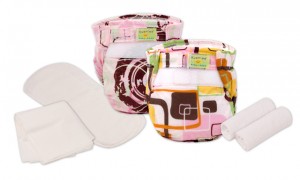
Cloth diapers can seem very intimidating at first, there are so many types and what works for your friend/sister/moms-cousins-hairstylist may not always work for you. The best way to find out what does work for you is to try them. There are many stores ( both online and store fronts) that will allow you a trial system with a few different types of diapers, test them out for a few weeks and just use the ones you like.
Generally you will need approximately 30 diapers to make up your stash, this will have you washing your diapers every two - three days. Your stash can be made up of all one type of diaper or a combination of the many different types.
Typically, though not always, you’ll need two parts to your cloth diapering system – the absorbant diaper, and the waterproof cover. There are a variety of different types of diapers you can choose from:
 Flats
Flats
These are one-layer diapers, generally made out of 100% cotton gauze and are the most “old-fashioned” choice. The advantages are that they dry extremely quickly and fit a large range of size. The disadvantages are the folding and pinning that are required.
 Prefolds
This is one of the most popular options. They are similar to flats, but have multiple layers with more layering in the middle. They are referred to as 2x6x2’s, 4x6x4’s, 4x8x4’s etc. These numbers refer to the number of layers in the sides and middle of the diaper (i.e., 4x6x4’s have 4 layers in the sides and 6 in the middle).
They come on a multitude of sizes from preemie to toddler. The stitching on the edges of the prefolds are usually coded to tell you the size (for example, dark green = infant, white = regular, dark blue = premium). Prefolds come in bleached or unbleached (abbreviated as BCPF or UBCPF).
Prefolds need to be pinned, snappi’ed, or folded into a trim fitting wrap-style cover. Hemp prefolds are another variation and are more absorbent but much more expensive than cotton prefolds, but can be a good option for nighttime diapering Prefolds store easily, dry quickly, fit a wide range of body types and sizes, don’t have elastic/snaps/velcro to wear out and are very absorbent.
 Fitteds
This is another popular option. Fitted diapers have elastic at the legs and back and basically look like a disposable diaper (only much cuter, of course). They can have velcro or snap fasteners, plain or printed outers, and can be made from a variety of materials like organic cotton or hemp. There is a veritable smorgasbord of women making diapers from their homes catering to any size, shape, wetting ability, etc. of your child. They are often referred to as work-at-home-moms (WAHM’s).
 All-in-ones (AIO's)
All-in-ones are the absorbent part of the diaper and the cover combined into a single diaper, just like disposables. Again, there are a million WAHM AIO’s to choose from.
The advantage of AIO’s are their ease of use (These diapers are often referred to as "husband friendly" because they are just as simple to use as disposables).
 Pocket Diapers
 There’s one other category of diapers called the pocket diaper. These have a layer of fleece sewn to a cover (either fleece or PUL) with an opening in the back so that the inside of the diaper can be stuffed with any absorbant layer from CPF’s, to specially made stuffers , hemp prefolds, or even hand towels. The fleece lining wicks moisture away from babies' skin, leaving it dry to the touch. There are also many WAHM pocket diapers with cute prints.
 Covers
There are several different styles of covers:
1) wrap – this refers to covers, which can be velcro or snap closing, that fasten in front, like disposable diapers. These can be used with fitteds, pinned prefolds, or unpinned prefolds;
2) side closing – these are usually snap closing covers, but there are some side-aplix covers out there. They can be used with fitteds or pinned prefolds;
3) pull-on – Pull-ons have the advantage of being quick and easy to get onto a squirmy toddler (even if they’re standing up), but they have the drawbacks that they can only be used with fastened prefolds or fitted diapers.
Covers also come in a variety of materials. One of the most common is polyurethane laminate (PUL). This is a polyester fabric with a waterproof coating applied to it. It’s trim and relatively leak-proof.
Waterproofed nylon is used in some covers. This is the trimmest, most leak-proof material. However, it also not that breathable and takes a little TLC (it shouldn’t be washed in hot water and should be line-dried).
Then there’s polyester fleece. Fleece can be very breathable, depending on what type it is. . However, it’s pretty bulky and can wick moisture onto clothing if it’s compressed for a long period of time (like during a long car ride).
Finally, there’s wool, which a lot of people consider to be the ultimate cover material. It’s natural, breathable, moisture-resistant, and anti-bacterial.
 Doublers and Liners
Doublers are used to add absorbancy to your diapers. They're a great solution for naptime and overnights if you don't want to get a whole new diaper just for these heavier wetting situations. You can also use fleece liners. The advantages of fleece liners is that they keep your baby's butt drier than being directly against wet cotton, and poop tends to peel off of them.
The simplest way is to buy flushable liners that you just take out and flush.
For more info on diaper types check out Diaper Pin